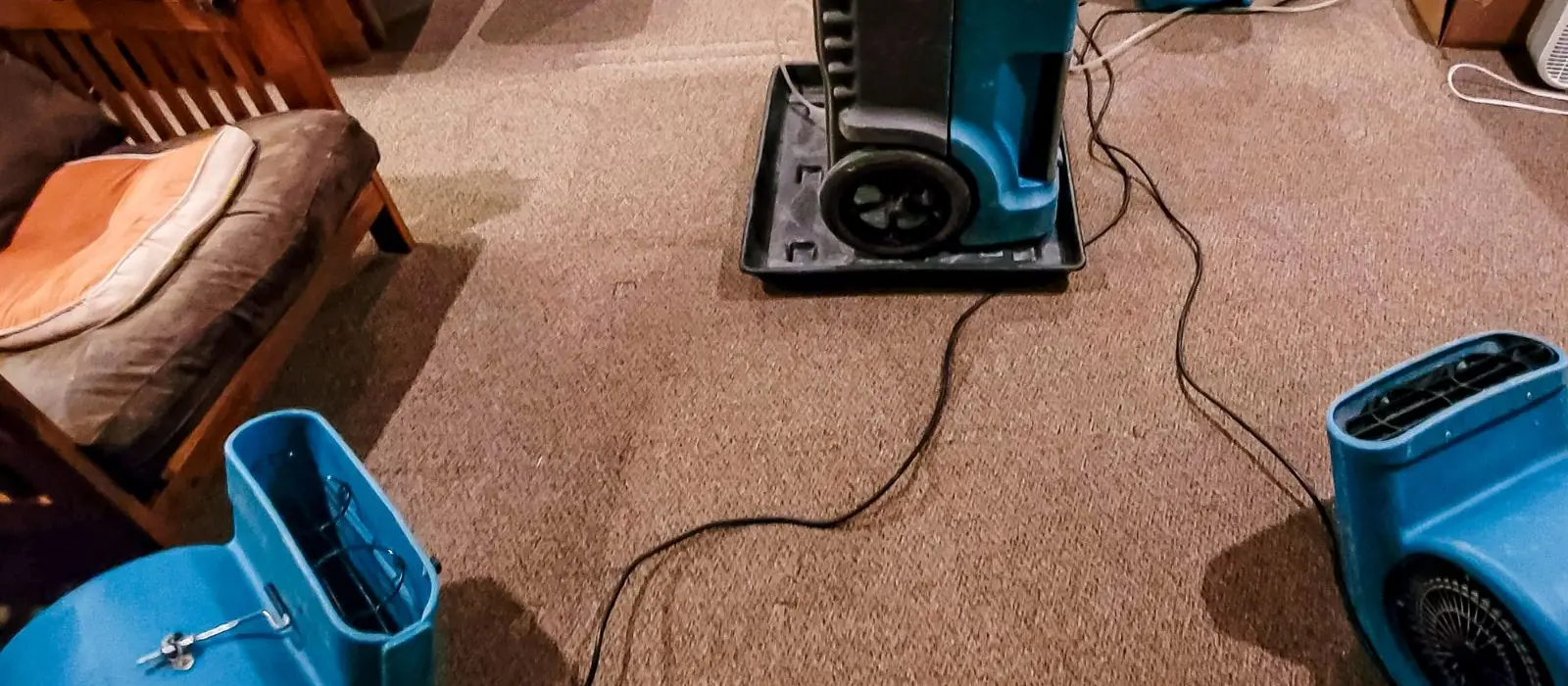
A burst supply line, a failed washing machine hose or a nor'easter that pushes water under a door leaves more than a wet floor. The water wicks into drywall, soaks into subfloor seams and settles into the cavity between studs. Structural drying is the work of finding all of that moisture and removing it from the building until the materials return to normal readings.
Most homeowners search this term after the standing water is already gone and the house still feels damp. That feeling is accurate. Surfaces can look dry to the eye while the lumber behind them still holds enough moisture to cause trouble.
What a drying crew is actually trying to remove
Liquid water sits in porous materials like carpet pad, plaster and untreated wood. Water vapor hangs in the air and settles back into cooler, drier surfaces if room humidity stays high.
A drying plan deals with both. Air movers speed evaporation from wet surfaces, and dehumidifiers capture the vapor so the air can keep absorbing more.
The industry reference for this work is ANSI/IICRC S500, the published standard for professional water damage restoration. It classifies water by contamination level (clean, gray or black water) and classifies the loss by how much wet material is involved and how quickly it will give up moisture. You can ask any company whether its crews work to S500, and a straight answer is a reasonable first screen.
How a structural drying job runs, step by step
Stop the source and remove standing water
Nothing dries while water is still arriving. Extraction with pumps or wet vacuums comes first, because every gallon removed as liquid is a gallon the dehumidifiers will not have to handle as vapor.
Map the moisture
Technicians use moisture meters on walls, floors and trim, often with a thermal camera to spot cool damp zones. Readings are marked on the surfaces or logged on a sketch so the wet area is a documented footprint, not a guess.
Set equipment
Air movers are placed to push air across wet surfaces, and dehumidifiers are sized to the volume of the space. Wet baseboard, carpet pad or flooring may be removed so trapped water has a path out.
Monitor daily
The crew returns to re-read the same points, record room temperature and humidity, and adjust the equipment. Dry spots get their air movers pulled and moved to wetter areas.
Confirm the drying goal and pull equipment
Equipment comes out only when readings in the affected materials match the reference readings from unaffected material of the same type in the same building. That final set of numbers is your proof the structure is dry.
Why it is not just fans
A box fan moves air across wet carpet and feels like progress. In a closed house, that air picks up moisture and carries it to the next cool surface. Without a dehumidifier, room humidity climbs and drying slows or stops.
- Fans cannot reach moisture inside wall cavities, under cabinet toe kicks or beneath hardwood without a plan to open those spaces or force air into them.
- Without readings, there is no way to know when to stop, so the house is either dried too little or left running far too long.
- Uncontrolled humidity after a loss is the condition that lets mold establish itself on damp drywall and framing.
Need the wet area measured and dried?
Describe what got wet and where the water came from, and dispatch will tell you what comes next.
LGR and desiccant dehumidifiers: what each one does
An LGR (low grain refrigerant) dehumidifier is a refrigerant-based unit built to keep pulling moisture even as the air gets drier. It is the common workhorse for typical household losses in a heated house. A desiccant dehumidifier passes air through a drying wheel that absorbs vapor, and it keeps working in cold spaces and at very low humidity.
A cold basement or a dense material that releases moisture slowly may call for desiccant, while a warm first floor usually does fine with LGR.
How long drying takes by material
Drying time is set by what got wet more than by how much water was spilled. The ranges below are general patterns, not promises, and a given job may run shorter or longer depending on equipment, temperature and the length of time materials stayed wet.
| Material | How it holds water | Usual drying pattern | What to ask the crew |
|---|---|---|---|
| Drywall | Absorbs quickly through the paper face and bottom edge | Often dries in place if caught early, may be cut out if saturated or sagging | Was it measured before deciding to remove it? |
| Carpet and pad | Pad soaks like a sponge | Carpet can sometimes be dried in place if the water was clean, pad is commonly replaced | Was the water category confirmed? |
| Framing and subfloor lumber | Slow to absorb and slow to release | Typically the longest to reach its goal in a normal job | What are the lumber readings today? |
| Hardwood flooring | Swells and can cup as it takes on moisture | Can take longer and sometimes needs specialty drying mats | Will you tent or mat the floor? |
| Plaster and masonry | Dense, holds moisture deep inside | Often needs the most time and low-humidity equipment | Is desiccant equipment being considered? |
Drying goals, monitoring and when the job is finished
A drying goal is a target reading, set from dry materials in the same home, that the wet materials must reach. It keeps the job from ending because someone feels it is dry enough.
Ask to see the daily log. A good one lists the date, room readings, the moisture content of the same marked points, and any equipment moved. If the numbers are not falling from one visit to the next, the crew should explain what they are changing.
Safety note
Do not run extension cords through standing water or touch outlets, switches or appliances in wet rooms. If water is touching electrical panels, call 911 or your electric utility before anyone calls a restoration company. A ceiling that is bowing or dripping steadily can fail without warning, so keep people out from under it.
Marblehead note: the 48 hour drying expectation
The Massachusetts Department of Public Health homeowner mold guide states: "The Housing Code requires areas to be dried from leaks and floods within 48 hours." The same guide recommends that wet areas be dried within 24 to 48 hours and adds that after a flood it may be difficult or impossible to meet that window.
For a Marblehead homeowner, the practical point is to start measured drying early rather than waiting for the wet look to fade. Keep your own notes of when the water was found and when drying began, because those times matter later.
Source: Massachusetts Department of Public Health homeowner mold guide, mass.gov
Structural drying and your insurance claim
Many policies expect you to protect the property from further damage once a covered loss happens, and drying records show you did. Keep the moisture log, the equipment list and any invoices. Whether the loss is covered at all depends on your policy and the cause, so check your policy and ask your insurer before assuming either way.
If standing water is still present, emergency water removal comes first, and the drying itself is covered under water mitigation. Crews also serve nearby homes in Swampscott and Salem, so the same process applies if your property sits just over the line.
What changes the scope of a drying job
Water category
Clean supply-line water is handled differently from gray or black water, which can require removal of porous materials.
Class of loss
The number of rooms, the share of wet surfaces and the presence of dense materials all push equipment needs up.
Time since the loss
Water that sat for days has migrated further into framing and may have started to support mold growth.
Access
Cabinets, built-ins, multiple floors and finished basements need more planning to reach wet cavities.
Scope and price are explained before work starts, and the right number depends on those four items. Because each loss differs, the dispatch line is the place to get a number that applies to your property.
Frequently Asked Questions
What is structural drying?
It is the controlled removal of moisture from a building's structure, meaning framing, subfloors, walls and ceilings, using air movers, dehumidifiers and meters. The goal is to bring wet materials back to normal readings, not just to make surfaces feel dry.
How long does structural drying take?
Many typical household jobs take several days, but dense materials like hardwood, plaster and framing can take longer. The better answer comes from daily readings, which show whether the numbers are moving toward the drying goal.
Can I dry my house with box fans and a household dehumidifier?
For a small, clean-water spill caught within hours, that may be enough on exposed surfaces. It will not reach wall cavities or subfloors, and without a moisture meter you will not know if the structure is dry. If water reached walls or flooring, a measured approach is safer.
What does S500 mean for a drying job?
ANSI/IICRC S500 is the published industry standard for professional water damage restoration. It covers water categories, loss classes and drying practice. Ask any company whether its crews work to it and how they document their readings.
Does Massachusetts require wet areas to be dried within a set time?
The Massachusetts DPH homeowner mold guide says the Housing Code requires areas wet from leaks and floods to be dried within 48 hours. If you cannot meet that window on your own, call the dispatch line to get measured drying under way.