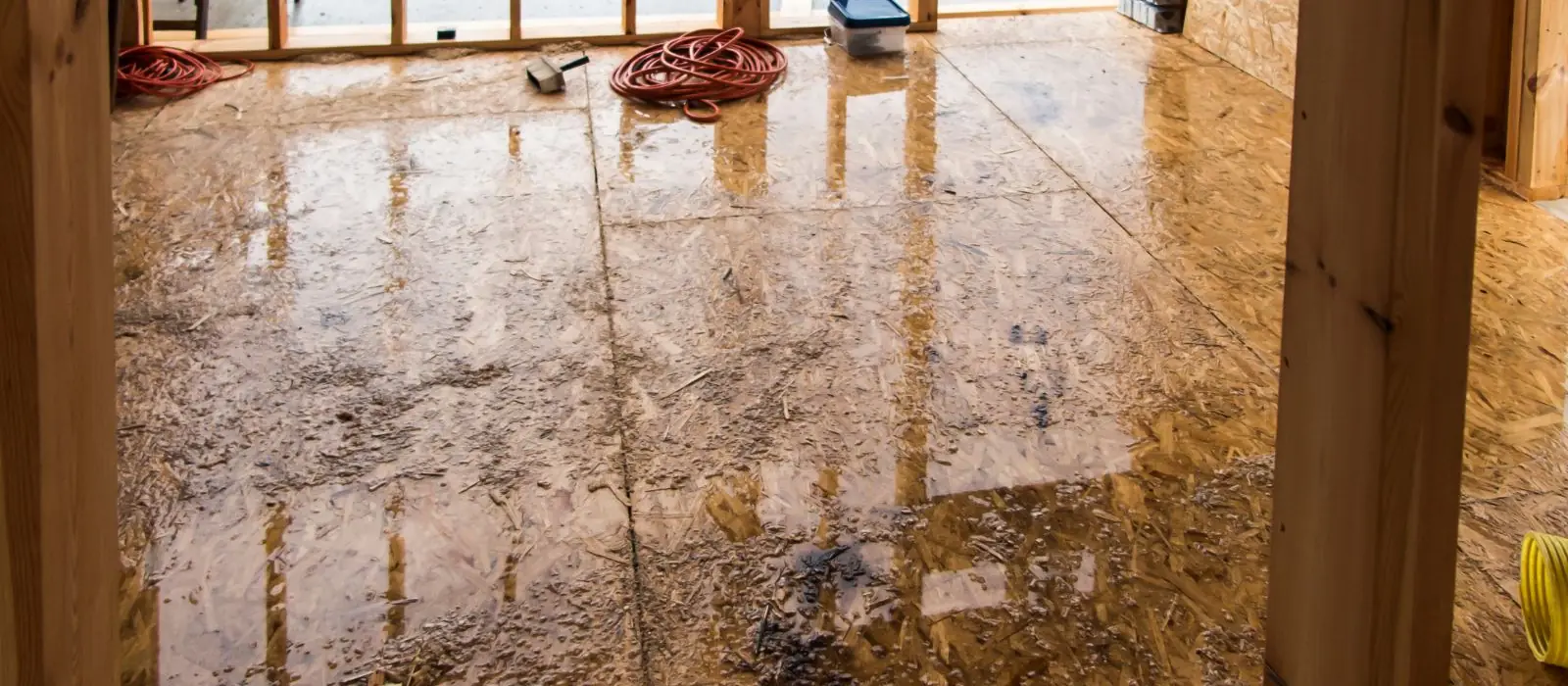
What the boards are doing, and what it means
Wood is hygroscopic, which means it takes on moisture and gives it back. Boards absorb water mostly from the bottom and edges, swell, and push against their neighbors. The shape they take tells you where the moisture came from and how bad the situation is.
Cupping
The edges of each board rise above the center. This is the most common pattern and usually means the underside is wetter than the top, from a leak, a damp subfloor or humidity below.
Crowning
The center of each board rises above the edges. It can appear after a cupped floor has been sanded while still wet, or when the top face has taken on more moisture than the bottom.
Buckling
Boards lift off the subfloor, sometimes in a ridge or tent. It signals a large amount of water or pressure, and it often means replacement of those boards.
Gaps, black marks or cracked finish
Gaps appear when boards shrink as they dry. Black marks at seams can mean long term moisture. Both are findings to document before any work starts.
Why timing matters more than almost anything else
Wood moves slowly, so damage keeps developing for days after the water is gone. The earlier water is removed and airflow starts, the better the chance that boards flatten as they dry. Boards that stay wet for long can darken, grow mold and lose their bond to the subfloor.
Do not judge a floor by how it looks on the first day. A floor that looks fine can still be wet, and a floor that looks bad can recover. Moisture readings in the boards and subfloor are what separate the two.
Drying, sanding or replacement: how the decision is made
| Condition | Likely path | Why |
|---|---|---|
| Clean water, caught quickly, boards slightly raised | Dry in place and re-check | Wood often flattens as moisture leaves, and no finish work may be needed |
| Mild cupping after drying, finish still sound | Wait until readings are stable, then sand and refinish | Sanding before the wood is stable can leave crowned boards |
| Severe cupping or buckling, boards lifted from subfloor | Replace the affected boards | Fasteners and bond are compromised and swelling is rarely fully reversible |
| Water stayed for days, dark staining or mold | Remove affected boards and treat subfloor | Staining and growth go through the wood, not just the finish |
| Floodwater or contaminated water | Treated as contaminated, usually removed | Flood-contacted wood cannot be assumed clean |
| Engineered wood or laminate | Often replaced | Layers and glue delaminate when saturated |
Nothing in the table is a promise. A floor that looks salvageable on day two may still move later, and a floor with a bad first week sometimes comes back. That is why the readings and a re-check matter.
Mistakes that make wet hardwood worse
- Sanding or refinishing before the wood and subfloor read dry. Trapped moisture shows up later as cupping, crowning or peeling finish.
- Covering the floor with plastic, rugs or tight sheeting, which slows evaporation and can cause mold.
- Using a heat gun, a hair dryer or a space heater, which can crack the surface and dry the top far faster than the base.
- Nailing down lifted boards before they have dried, which locks in the distortion.
- Waiting for the floor to dry on its own, when airflow and dehumidification are what pull moisture out of the wood and the subfloor.
How professionals dry a wood floor
Drying starts with extraction, then moves to airflow, dehumidification and, for wet hardwood, sometimes floor drying mats that pull moisture upward through the boards. Crews often drill small relief holes or lift a few boards along the wall to dry the subfloor and the cavity under it.
A floor over a basement or crawl space also needs attention underneath. If the air below stays humid, the boards keep re-wetting from the bottom, which is a common cause of cupping that returns after the first drying.
Hardwood wet and still damp underneath?
Call the dispatch line, and licensed and insured restoration professionals can check boards and subfloor for moisture. Scope and price explained before work starts.
Marblehead note: floors in flood-prone neighborhoods
The Massachusetts MVP planning grant report for Marblehead names flood-prone areas that include Ocean Avenue to Shipyard and Commercial Street, the streets around Marblehead Harbor (Walnut, Gregory and Front Street), and Lafayette Street (Route 114). Ground-floor wood in or near those areas faces tidal and storm flooding, and your own street may be different, so check the FEMA flood map for your address.
For a hardwood floor, the source of the water changes the plan. Water from the harbor is saltwater and often carries silt and contamination, so flood-contacted wood is treated differently from wood wetted by a clean supply line. Under ANSI/IICRC S500, category 2 and category 3 water are not treated like clean water, which is why a flooded floor is more likely to be removed than dried.
Source: Massachusetts MVP Planning Grant Report for Marblehead, mass.gov
What the water source says about your floor
Clean supply or appliance leak
The best case for saving wood. Fast extraction, airflow and drying mats can bring floors back, particularly solid planks.
Rain or roof water
Usually treated as clean at first, but it picks up dirt as it travels through the structure. Insulation and subfloor often need attention too.
Flood, storm surge or sewage
Treated as contaminated. Expect removal of flood-contacted flooring and cleaning of the subfloor.
Sudden and accidental water damage is often covered by homeowners policies. Gradual leaks often are not, and standard homeowners policies do not cover flood damage, which needs separate flood insurance. A rider for sump pump failure or water backup may offer some coverage, so check your policy and ask your insurer, and photograph the floor before anything is moved.
If your floor was soaked by a failed pipe or storm water, water damage repair and flood damage restoration are the services to ask about, and Marblehead Water Damage Pros dispatches to Swampscott and Lynn too.
Frequently Asked Questions
Can cupped hardwood floors flatten on their own?
Often, yes, if the water source is stopped and the floor dries slowly and evenly. Many cupped floors improve over weeks as moisture leaves.
Do not sand until readings are stable, or the floor can crown.
How fast do I need to act on a wet hardwood floor?
As quickly as possible. Wood keeps absorbing while water is present, and the longer boards stay wet the more likely they are to buckle, stain or grow mold.
Remove standing water, start airflow and call for moisture readings.
When does a wet hardwood floor need to be replaced?
When boards are buckled, delaminated, stained through, moldy or exposed to contaminated water. Flood-contacted wood is generally treated as contaminated.
Floors that cupped slightly and dried can often be sanded and refinished instead.
Is flood water different from a pipe leak for hardwood?
Yes. A clean supply leak is category 1, while floodwater from outside is generally treated as category 3. Under ANSI/IICRC S500, contaminated water changes the cleaning and removal plan.
Saltwater from a harbor storm also leaves residue that clean water does not.
Does Marblehead have flood-prone areas that affect ground-floor wood floors?
The state MVP planning report for Marblehead names areas such as Ocean Avenue to Shipyard and Commercial Street, the Marblehead Harbor streets of Walnut, Gregory and Front, and Lafayette Street (Route 114). Ground-floor flooring in those areas is exposed to tidal and storm flooding.
Check the FEMA flood map for your address and keep in mind that standard homeowners policies do not cover flood.
Should I pull up the boards myself?
Not before photographing the floor and getting a moisture reading. Removing a few boards can help dry the subfloor, but pulling boards can also damage tongue and groove edges you could have kept.
If the water was contaminated, wear gloves and leave removal to professionals.